-HITIONS’ Titanium & Stainless Steel machining solution for orthopedic implants manufacturing
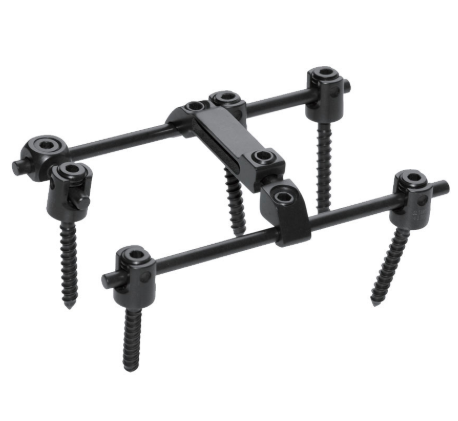
Orthopedic implants, let’s say cages, screws, rods, and plates—are essential components in spinal fusion surgery. They work together with bone grafts to stabilize vertebrae, restore alignment, and relieve nerve compression. Acting as a temporary structural framework, these implants keep the spine in place while the graft heals and the vertebrae fuse into a single, solid bone. Therefore, select the right machining supplier orthopedic implants manufacturing is vital important.
Now, let’s examine the challenges in their processing and potential solutions.
1. Tackling Titanium’s Machining Challenges for orthopedic implants
Titanium’s Benefits
Ti-6Al-4V offers exceptional tensile strength (≥900 MPa), a favorable low modulus (110 GPa), and excellent compatibility with the human body.
However, its poor thermal conductivity—around one-fifth that of steel—creates significant challenges during machining. These include:
Accelerated tool wear
Cutting force instability
Formation of residual oxide layers on the surface
HITIONS’ Manufacturing Approach
To address these issues, we use PCD-coated tools and a high-pressure coolant jet system operating at up to 300 bar. This keeps cutting temperatures below 20 °C—down from the typical ~800 °C—extending tool life by 300% and maintaining surface roughness within Ra 0.2 μm. Dig further about Challenges with Innovative Strategies in Titanium Alloy Machining.
2. Precision Geometric Control for orthopedic implants
In spinal fixation systems, geometric tolerances directly impact surgical safety and implant longevity. For example:
Pedicle screws require a thread pitch error no greater than 0.01 mm
Connecting rods must maintain ±0.05 mm bending radius tolerance to avoid stress points
HITIONS’ Solutions
We use five-axis linkage machining centers (DMG MORI DMU 200P) with dynamic tool compensation to eliminate vibration bias in real time.Our hydraulic expansion mandrel fixtures deliver ≤0.002 mm repeat positioning accuracy for flawless part alignment. On-machine probing (Renishaw RMP600) performs continuous closed-loop inspection during production, ensuring zero defects.
3. Thread Perfection Through Single-Point Diamond Turning
Conventional roll forming can distort titanium’s grain structure, compromising performance. HITIONS applies Single-Point Diamond Turning (SPDT) with nanoscale toolpath control to achieve tooth profile angle errors within ±8′—significantly better than the typical ±30′ standard.
Every thread undergoes 100% inspection using precision gauges and laser scanning with 0.5 μm accuracy, guaranteeing flawless geometry.
4. Advancing Surface Bioactivity
While anodizing was once the default finish for titanium spinal implants, long-term load testing revealed a risk of oxide layer delamination. To improve durability and patient outcomes, HITIONS developed a Micro-Arc Oxidation (MAO) process that:
Forms a dense ceramic coating (5–10 μm thick) with hardness up to HV1200
Increases wear resistance by 5×
Uses a calcium-phosphorus electrolyte formula to enhance bioactivity and speed osseointegration
Why HITIONS is a Trusted Partner in Orthopedic Implant manufacturing
HITIONS combines CNC machining, additive manufacturing, and medical-grade process management to produce orthopedic implants with unmatched precision, surface integrity, and biocompatibility.
We machine titanium, stainless steel 316, and PEEK, ensuring every step—from raw material selection to final inspection—meets strict clinical standards.
Innovations in cutting technology, geometric control, thread formation, and bioactive surface treatments guarantee each implant is accurate, durable, and optimized for patient success.